
The Imagined Legal Reckoning
The RoomThis flow follows the prisoner’s repeated fantasy that courtroom performance can reverse his powerlessness and expose officers whose accounts of his arrest collapse under questioning.
increasing Bearing strength in each event
 decreasing
Bearing strength in each eventdecreasingThe First Hearing’s Confusion
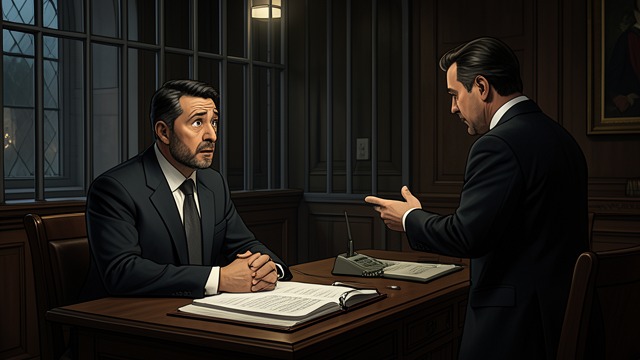
The First Hearing’s Confusion
A language he cannot follow
At the preliminary hearing, the prisoner hears legal formulas and exchanges without fully understanding them. He wants to take notes and identify weaknesses in the prosecution’s account, but his attention falters under the pace and unfamiliarity of the proceedings. The hearing leaves him feeling present but unable to participate meaningfully.
Counsel as another source of distrust
He watches the public defender confer and imagines that his appointed lawyer has already failed him. Procedures that may be ordinary to the participants appear to him as a ritual that protects itself rather than a process that examines his case. His sense of abandonment becomes intertwined with his suspicion of the legal system.
A defeat that feeds later fantasies
The hearing does not resolve the charges, and he returns to the cell with anger at what he sees as passivity and procedural games. His wish to master the courtroom grows from this experience of not being able to make himself understood. Later imagined courtroom victories answer the helplessness he experiences here.
The Victorious Defense Fantasy
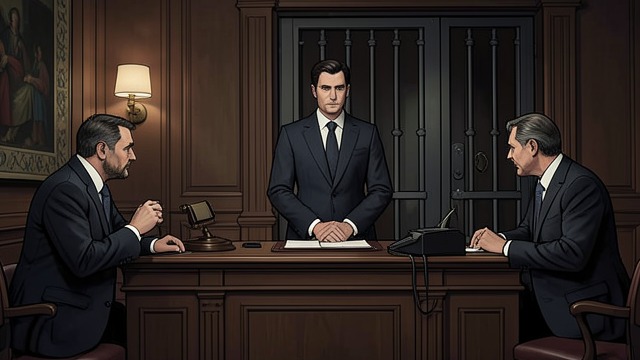
The Victorious Defense Fantasy
A different lawyer, a different outcome
The prisoner imagines Stacey Lowry taking his case and winning an immediate dismissal with a concise legal argument. He leaves the courtroom free and meets Donald Preston, who welcomes him as a partner in a public campaign. This imagined sequence reverses the actual frustration of sitting beside counsel he believes has done nothing for him.
Control replaces confusion
In the fantasy, legal proceedings are brief, comprehensible, and decisive. A motion succeeds, the court accepts the argument, and the prisoner understands his own importance to what follows. The contrast with the first hearing reveals that his imagined mastery is less a careful reconstruction than a wish to rewrite the experience of exclusion.
The victory remains mental
The scene is woven into the prisoner’s stream of imagined events rather than established as an actual release. Its promise of freedom is temporary and depends on continued fantasy. The imagined dismissal therefore does not resolve the real structure of confinement; it provides a momentary counter-scene in which the law appears to serve him.
Choosing to Defend Himself
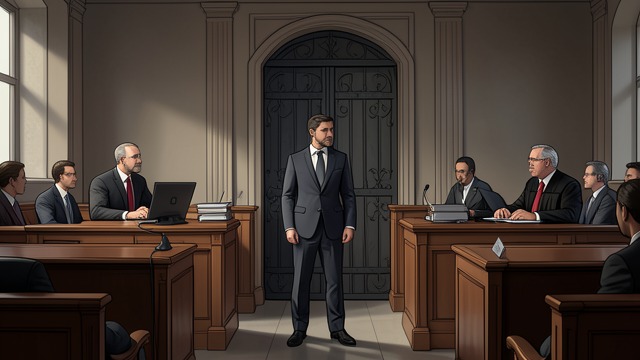
Choosing to Defend Himself
A role seized in imagination
The prisoner imagines waiving counsel and addressing the court on his own behalf. He wants to question the officers who arrested him and expose contradictions without relying on a lawyer he distrusts. In this imagined trial, he will no longer be a silent defendant waiting for others to speak for him.
Legal procedure as obstacle
His confidence is repeatedly checked by the imagined judge and prosecutor, who object, limit his questions, and insist on courtroom rules. He recognizes the possibility of legal protections in theory, yet experiences their application as another power that can interrupt and redirect him. The conflict becomes a struggle not only against police testimony but against the procedure governing how it may be challenged.
A fragile claim to agency
His fantasy of self-representation offers a form of control, but the rules he resents are also part of the imagined arena in which he hopes to win. Each restriction deepens his conviction that no matter how well he argues, institutions can stop him. The scene thus turns the promise of speaking for himself into another source of frustration.
The First Officer Unravels
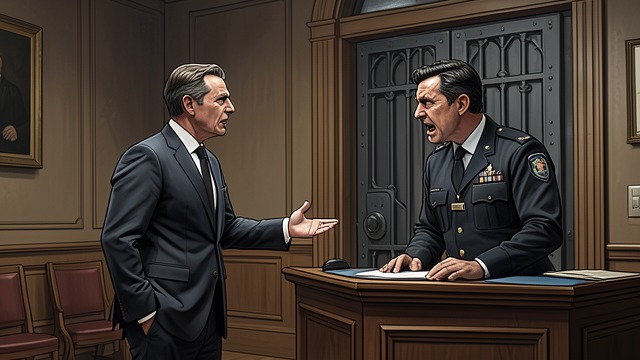
The First Officer Unravels
A testimony tested in detail
In the imagined trial, the prisoner questions an officer about the time, distance, traffic light, and view near Hill Street–Hill Avenue intersection. Each answer becomes the basis for a narrower question, and the witness struggles to keep his account consistent. The prisoner turns small factual details into pressure points.
Authority loses its composure
The officer grows irritated, contradicts himself, and eventually threatens the prisoner from the witness stand. The judge orders him removed, while the prisoner’s imagined counsel calls attention to the officer’s apparent inability to testify reliably. The scene transforms the officers’ physical and institutional authority into visible courtroom instability.
Vindication through spectacle
The prisoner imagines the courtroom audience observing the failure and reacting to his performance. That imagined audience matters as much as the inconsistencies themselves: he wants not only to defeat the account but to be publicly recognized as its master. The courtroom becomes a stage for reversing the humiliation he associates with arrest and detention.
The Second Officer’s Collapse
The Second Officer’s Collapse
A disputed sighting
The prisoner imagines questioning the second officer about identifying a figure near Kramers Jewelry Store at night. Questions about lighting, distance, movement, and the officer’s ability to observe turn certainty into a series of qualifications. The witness’s account becomes less stable as the imagined examination separates what he saw from what he assumes.
A hidden accusation surfaces
The questioning shifts to the beating and to a woman’s alleged assault by the officers. The witness denies knowledge, then appears to reveal details that the prisoner treats as signs of guilt. The testimony moves from the jewelry-store encounter toward the imagined crime against Mrs. Haagstromm, making the trial fantasy a vehicle for linking distinct grievances.
Rage replaces orderly argument
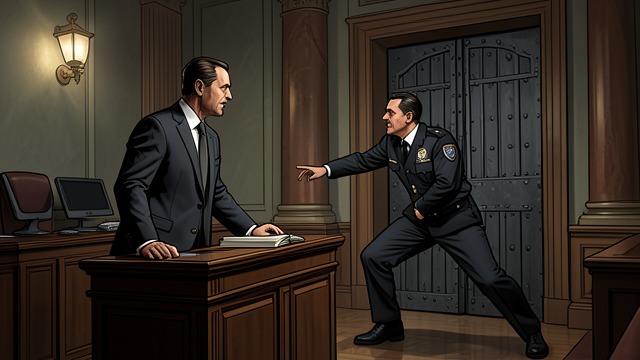
The officer finally leaps toward the prisoner and is removed from court, after which the judge orders a psychiatric examination. The prisoner imagines legal victory as a dramatic collapse of his opponents’ credibility, but the scene’s violence also echoes the aggression that dominates his private fantasies. The courtroom triumph is therefore inseparable from his desire to punish.
Early in his detention, during his preliminary hearing
After the preliminary hearing, during a later imagined return to court
Later in the cell, as he imagines a trial over his arrest
During the imagined cross-examination of the first arresting officer
Later in the same imagined trial, during questioning of the second officer
